The Fundamentals of Blockchain Technology: An In-Depth Guide for Beginners.
Blockchain is often hailed as the backbone of the digital age, yet it remains one of the most misunderstood concepts in modern technology. While many people immediately associate it with Bitcoin or speculative trading, the underlying technology is far more profound. At its core, blockchain is a radical method of recording information that makes digital tampering, hacking, or systemic cheating virtually impossible. In this guide, we will break down the fundamentals of blockchain technology in extensive detail.
1. Defining Blockchain: A New Paradigm of Data Storage
To understand blockchain, it is helpful to contrast it with traditional databases. Most databases are centralized, meaning they are managed by a single authority—a bank, a government entity, or a large corporation. In these systems, you must trust that the central authority is honest and that their security systems are impenetrable. If the central server is compromised, all data is at risk.
A blockchain, however, is a distributed ledger. Instead of being held in one central server, exact copies of the ledger are stored across thousands of computers, known as “nodes,” worldwide. Each node maintains a complete, synchronized record of every transaction ever processed on the network. This decentralization removes the need for a single “gatekeeper,” as the trust is shifted from a person or corporation to an immutable, mathematical protocol.
2. The Historical Context and Evolution of Blockchain
Blockchain did not appear overnight. It is the result of decades of cryptographic research. Long before Bitcoin, computer scientists explored “Merkle Trees”—a data structure that allows for the efficient and secure verification of large data sets. Additionally, the concept of “Hashcash,” an early proof-of-work system, laid the groundwork for preventing spam and distributed denial-of-service (DDoS) attacks. Satoshi Nakamoto combined these elements in 2009 to solve the “double-spending problem,” creating the first truly functional, decentralized digital currency.
3. Anatomy of a Blockchain: The Technical Mechanics
The term “blockchain” comes from its literal structure: it is a chronological chain of data blocks. Here is the technical breakdown of how this process works in detail:
A. Data Entry and Packaging (The Block)
When a new transaction occurs—such as the transfer of a digital asset—the information is bundled with other recent transactions into a “block.” This block acts as a container for data, timestamped to ensure the sequence of events is preserved.
B. Cryptographic Hashing (The Digital Fingerprint)
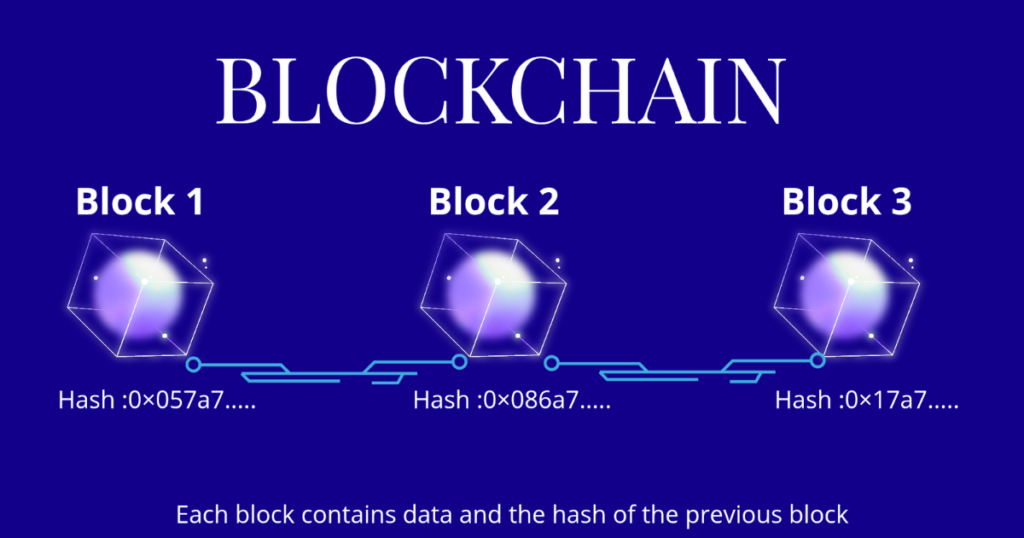
Every block is assigned a unique code called a “hash.” This is a digital fingerprint generated by a mathematical algorithm (such as SHA-256). Crucially, if even a single character of data within the block is altered, the entire hash changes completely, immediately signaling that the block is no longer authentic.
C. Consensus Validation (The Network’s Truth)
Before a block is added to the chain, the network of nodes must reach a “consensus.” This ensures that the transaction is legitimate. Whether through Proof of Work (PoW) or Proof of Stake (PoS), the network verifies that the sender has the required assets and that no double-spending has occurred.
D. Linking (The Cryptographic Chain)
Every block includes the hash of the block that preceded it. This creates a cryptographic link that binds the blocks together in a rigid sequence. If a malicious actor tries to alter data in a block from the past, the hash of that block changes, which breaks the link to every subsequent block in the chain. The rest of the network will see that the hashes no longer match and will reject the altered version.
4. The Pillars of Blockchain Security
Blockchain security is based on three fundamental pillars that make it superior to legacy data systems:
I. Decentralization and Resiliency
There is no “single point of failure.” If a group of nodes goes offline, the network continues to operate, making it resistant to censorship, server crashes, and physical attacks.
II. Immutability
Once data is written, it becomes permanent. To rewrite history, an attacker would need to control more than 51% of the network’s computing power, which is practically impossible for mature networks like Bitcoin or Ethereum.
III. Transparency and Privacy
While transactions are public and verifiable, user identities are protected behind encrypted “addresses,” balancing the need for transparency and anonymity. This allows for public auditability without compromising sensitive personal data.
5. Public vs. Private Blockchain Systems
It is crucial to distinguish between different types of blockchain:
- Public Blockchains (Permissionless): Examples include Bitcoin and Ethereum. Anyone can join, participate, and read the ledger. They are completely transparent and decentralized.
- Private Blockchains (Permissioned): Often used by corporations (e.g., Hyperledger). Only authorized participants can join. These are faster and more energy-efficient but prioritize control over complete decentralization.
6. The Rise of Smart Contracts
Blockchain has evolved beyond simple “cash” transactions. With the introduction of Smart Contracts—self-executing contracts with the terms of the agreement directly written into lines of code—blockchain can now facilitate complex, automated agreements. Once the pre-defined conditions are met, the contract executes automatically without the need for a lawyer, notary, or intermediary. This is the foundation of Decentralized Finance (DeFi).
7. Real-World Applications
Blockchain’s utility extends far beyond currency:
- Supply Chain Management: Tracking products from factory to consumer to verify authenticity.
- Healthcare: Providing secure, patient-controlled medical records.
- Democratic Voting: Creating transparent and immune-to-manipulation voting systems.
- Real Estate: Streamlining home buying into a secure, digital title registry.
8. Challenges and the Future
Despite its potential, blockchain faces hurdles:
- Scalability: Handling thousands of transactions per second is a technical challenge being addressed by “Layer 2” solutions.
- Energy Consumption: Older consensus methods are energy-intensive. The industry is shifting toward greener alternatives like Proof of Stake.
- Regulatory Frameworks: Governments are still developing legal structures to protect users without stifling innovation.
Conclusion
Blockchain is fundamentally a technology that shifts trust from centralized institutions to mathematics and code. By removing the need for fallible intermediaries, we are opening the door to unprecedented levels of efficiency, transparency, and security. As we move toward a digital-first future, understanding the fundamentals of blockchain is essential for anyone wanting to participate in the next generation of the internet.