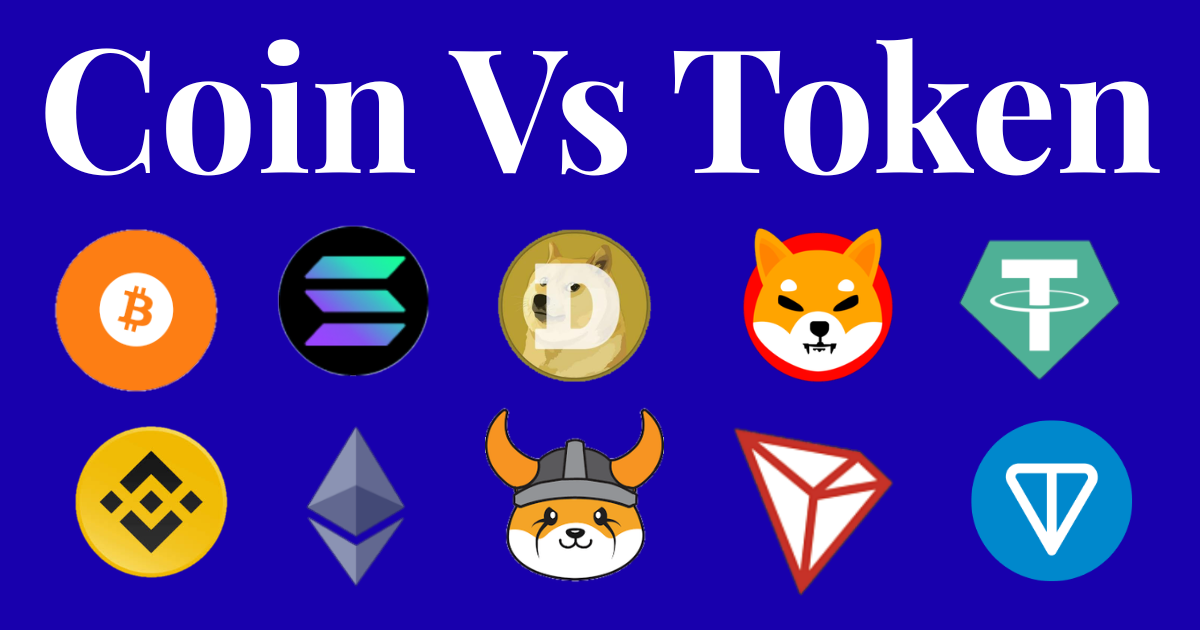
When you first step into the world of cryptocurrency, you are immediately bombarded with hundreds of new terms that can sound entirely foreign. Among the many technical terms thrown around, two of the most frequently used—and often interchangeably misused—words are “Coin” and “Token.”
Many beginners, and even some mainstream media outlets, use these terms as if they mean the exact same thing. They might call Bitcoin a token, or refer to Shiba Inu as a coin. However, from the perspective of fundamental technology and their function within the blockchain ecosystem, coins and tokens are two completely different digital entities.
For an investor or digital asset user, understanding the fundamental difference between a coin and a token is not just a matter of vocabulary. This knowledge is crucial for evaluating a crypto project’s fundamentals, understanding how transaction fees (gas fees) work, and measuring the level of risk before you decide to invest your hard-earned money. In this comprehensive guide, we will unpack exactly what a coin is, what a token is, the main differences between the two, and why this matters for your investment journey.
What is a Crypto Coin?
In simple terms, a Crypto Coin is a digital asset built on and operating within its own independent blockchain network. A coin is the native currency of a blockchain ecosystem. If you imagine a country, a coin is the official fiat currency printed by that country’s central bank and used for all economic activities within its borders.
Key Characteristics of a Coin:
- Independent Network: This is the absolute prerequisite for a digital asset to be called a coin. Bitcoin (BTC) operates on the Bitcoin blockchain. Ethereum (ETH) operates on the Ethereum network. Cardano (ADA) runs on the Cardano network. They do not piggyback on third-party networks.
- Functions as Money and Store of Value: Since their inception, the primary purpose of most coins has been to function much like traditional (fiat) money. Coins were created as a medium of exchange, a unit of account, and a store of value.
- Paying Transaction Fees (Gas Fees): Within a blockchain network, every transaction or activity requires computational power. The native coin of that network is used to pay these computational fees to the miners or validators who secure the network.
Examples of Popular Coins:
- Bitcoin (BTC): The pioneer of all cryptocurrencies. BTC is the native coin of the Bitcoin network, globally recognized as the most secure digital store of value.
- Ethereum (ETH): Although Ethereum is a platform where thousands of applications are built, ETH itself is the native coin used to power all activities on the network.
- Solana (SOL) & Binance Coin (BNB): Both have their own independent blockchain networks with different speeds and fee structures.
Building a coin from scratch is no easy task. Developers must design cryptographic architecture, determine consensus mechanisms (like Proof of Work or Proof of Stake), and gather a community of miners or validators to secure the network against hacks. Therefore, coins are generally considered to have heavier and more solid fundamentals compared to tokens.
What is a Crypto Token?
If a coin has its own network, a Crypto Token is a digital asset created on top of an existing, third-party blockchain network. Token creators do not need to build a blockchain from scratch; they simply rent or utilize the infrastructure already provided by public blockchain networks like Ethereum, Binance Smart Chain (BSC), or Solana.
Tokens are created using pieces of programming code called Smart Contracts. These smart contracts govern how the token is created, distributed, and transacted.
Key Characteristics of a Token:
- Piggybacking on Another Blockchain: Tokens do not have their own ledger or mining infrastructure. They rely entirely on the security and stability of the host blockchain they reside on.
- Fast and Cheap Creation Process: Because there is no need to build a new blockchain network, creating a token is much easier. By using existing standards (like ERC-20 on Ethereum or BEP-20 on Binance Smart Chain), a developer (or even a beginner) can launch a new token in a matter of hours with very minimal capital.
- Highly Specific Functions (Utility): Unlike coins, whose primary purpose is to act as digital money, tokens are usually created to represent specific utilities, assets, or voting rights within a decentralized application (DApp) or ecosystem project.
Examples of Popular Tokens:
- Tether (USDT): This is a stablecoin pegged 1:1 to the US Dollar. USDT does not have its own blockchain; it is issued as a token across various networks like Ethereum, Tron, and Solana.
- Uniswap (UNI): This token is used as a governance tool on the Uniswap decentralized exchange, which operates on the Ethereum network.
- Shiba Inu (SHIB): Despite its popularity, SHIB is not a coin. SHIB is an ERC-20 token that piggybacks entirely on the Ethereum network.
The Simple Analogy: Landlord vs. Tenant
To help you instantly visualize the difference between a coin and a token, let’s use a real-world analogy: a Shopping Mall.
- The Coin is the Mall Owner (The Landlord): The owner builds the foundation of the building, installs the electrical system, hires security guards, and ensures all infrastructure functions properly. The mall owner has their own currency (the Coin) used to pay for electricity, security, and building administration. (Example: The Ethereum Network and the ETH Coin).
- The Token is the Shop Tenant in the Mall: You want to open a business, but you don’t have the time and billions of dollars to build a mall from scratch. The solution? You rent an empty commercial space inside the mall. You are free to design your store, sell any goods, and issue your own store membership cards (Tokens). However, to pay for rent and electricity to the mall management, you still have to pay using the landlord’s currency (the Coin).

Key Differences (Detailed Breakdown)
To be more systematic, let’s compare these two digital assets across several key technical aspects:
1. Network Structure and Independence
This is the most absolute difference. A coin stands independently on its own blockchain. If a token project fails, only that token is destroyed. However, if there is a fatal issue with a blockchain (e.g., the Ethereum network gets hacked or goes offline), then the ETH coin and the thousands of tokens running on it will be entirely paralyzed.
2. Transaction Fees (Gas Fees)
This is a point that often confuses beginners and causes them to lose money. When you send a Coin (e.g., sending BTC), you pay the transaction fee with BTC itself. However, when you want to move a Token, you cannot pay the fee with that token.
Case Study: You hold Shiba Inu (SHIB) tokens in your crypto wallet and want to send them to an exchange. Because SHIB runs on the Ethereum network, you are required to have ETH Coins in your wallet to pay the gas fee. Without ETH, your SHIB tokens will be stuck and cannot be moved at all.
3. Purpose and Use Cases
Coins are created as money, a medium of exchange, or a digital commodity that supports network security. On the other hand, tokens have a much broader and more innovative scope of functions because their creative limits lie only within the smart contract. Tokens can represent company shares, digital art (NFTs), voting rights in a decentralized autonomous organization (DAO), or even reward points in a Play-to-Earn game.
4. Difficulty and Cost of Creation
Creating a successful coin requires massive resources. You need a highly skilled developer team, a strong whitepaper, a hack-resistant consensus system, and a global community willing to dedicate their computers to become network validators. In short, it takes years and millions of dollars.
Conversely, creating a token is often just a matter of copying and pasting available smart contract code on public platforms like GitHub, changing the token name, determining the total supply, and hitting deploy. The cost might be less than a hundred dollars. This ease of creation is why there are millions of tokens on the market today, but only hundreds of independent coins.
Categories of Tokens You Need to Know
Because tokens are much more flexible than coins, crypto developers have divided token functions into several main categories:
- Utility Tokens: These tokens give you access to a specific service or product. It is similar to an arcade coin; you have to buy that specific coin to play the gaming machines.
- Security Tokens: These are digital versions of traditional financial instruments like stocks or bonds. Owners of security tokens are usually entitled to dividends or a portion of ownership in Real-World Assets. These tokens are heavily regulated by state legal institutions.
- Governance Tokens: Owning these tokens means you have voting rights within a project. The more tokens you hold, the greater your voting power to determine the project’s future (e.g., to change service fees or allocate grant funds).
- Non-Fungible Tokens (NFTs): Unique tokens that cannot be exchanged on a 1:1 ratio with one another. NFTs are used to prove authentic ownership of digital assets like art, music, or virtual real estate in the metaverse.
Why Understanding This Matters for Investors?
For some, distinguishing between a coin and a token might seem like a boring academic debate. However, for those intending to allocate capital in the crypto market, this knowledge is an essential risk mitigation tool.
First, knowing this difference will save you from operational frustration. Many beginners panic when they see their USDT or SHIB token balances cannot be withdrawn from their wallet, simply because they don’t know they must hold a little ETH or BNB to pay the network fees.
Second, it is closely tied to portfolio risk management. Because coins have their own blockchains and require substantial capital to build, they generally have stronger fundamentals, higher liquidity, and slightly lower risk compared to tokens (although everything in the crypto market remains highly volatile and risky).
On the other hand, because anyone can create a token in 10 minutes, the token ecosystem is filled with scam projects, rug pulls, and memecoins with zero fundamental value. Knowing that an asset currently hyped on social media is just a “regular token” piggybacking on someone else’s blockchain should make you more cautious and prompt you to Do Your Own Research (DYOR) before investing.
Conclusion
The crypto world continues to evolve at an incredible pace, and the lines between coins and tokens sometimes blur with the emergence of Layer-2 and Layer-3 network technologies. However, the basic principle will always remain the same: Coins are the primary infrastructure foundation that owns its tracks, while Tokens are the clever passengers utilizing those tracks to create limitless applications and ecosystems.
As a smart investor, always ensure you research whether the asset you are buying is a coin or a token. Understand what blockchain supports it, know its function, and never forget to always keep a small amount of the native coin in your digital wallet to ensure smooth token transactions in the future. Happy, smart, and safe investing!
What do you think? Have you ever felt confused about whether a specific project is a coin or a token? Let us know in the comments below!
After you understand the differences between a coin and a token, the next crucial step is ensuring your assets are safe. If you’re wondering how to store them securely, you can check out our guide on how to secure your crypto and choose the right wallet here.