1. Executive Summary & Theoretical Framework
The dawn of Bitcoin in 2009 introduced the world to the revolutionary potential of a decentralized, distributed ledger capable of securely transferring value without traditional intermediaries. While Bitcoin successfully established a protocol for a peer-to-peer digital currency, its underlying scripting language was intentionally limited in functionality to optimize security and prevent complex loops. The true paradigm shift toward decentralized computational automation occurred with the conceptualization and launch of Ethereum. Ethereum expanded the blockchain from a mere static transaction ledger into a dynamic, global, turing-complete virtual computer powered by Smart Contracts.
At their core, smart contracts are self-executing deterministic cryptographic protocols with the terms of the agreement between parties directly inscribed into lines of code. Operating on decentralized infrastructure, these protocols independently monitor, verify, and execute transactions or states once pre-defined, mathematically verifiable conditions are met. They eliminate the reliance on centralized escrow agents, legal intermediaries, and third-party clearinghouses, thereby replacing systemic counterparty risk with mathematical certainty. In the contemporary digital asset ecosystem, smart contracts form the bedrock infrastructure that powers everything from multi-billion dollar crypto tokens (ERC-20, ERC-721) to multi-layered Decentralized Applications (DApps) and Decentralized Autonomous Organizations (DAOs).
2. Historical Lineage: From Vending Machines to Turing-Completeness
To grasp the profound technological impact of smart contracts, one must examine their conceptual lineage. The term and primitive architecture were first proposed long before the inception of blockchain technology. In 1994, renowned cryptographer and computer scientist Nick Szabo introduced the concept of a smart contract. Szabo famously utilized the analogy of a mechanical vending machine to explain the underlying logic.
A vending machine is fundamentally a crude hardware-based smart contract: it takes an input (fiat currency/coins), independently verifies the validity of that input, evaluates whether the input matches the price of the requested item, and automatically executes the transaction by dispensing the product and returning the correct change. No human intermediary or store clerk is required to oversee or validate the exchange. The rules of the transaction are hard-encoded directly into the physical configuration of the machine’s gears and circuits.
While Szabo laid the theoretical groundwork, the world lacked the decentralized financial infrastructure and cryptographic primitives required to execute these contracts in a trustless digital space. If a smart contract were run on a traditional centralized server, the server owner could arbitrarily alter the code, halt execution, or manipulate the database entries. The true execution of Szabo’s vision required an immutable, decentralized substrate where code execution could be verified collectively by a distributed consensus network.
In 2013, Vitalik Buterin published the Ethereum Whitepaper, identifying the ultimate missing piece. Buterin recognized that by integrating a Turing-complete programming language into a blockchain network, developers could write arbitrary logic for any asset, financial contract, or application imaginable. Launched in 2015, Ethereum turned the blockchain into an open, programmable infrastructure, catalyzing the multi-trillion-dollar web3 revolution we see today.
3. Architectural Underpinnings: How Smart Contracts Execute
The technical deployment and lifecycle of a smart contract are governed by rigorous computer science principles and cryptographic consensus rules. Understanding this architecture requires exploring three distinct layers: the high-level code, compilation into bytecode, and execution within a virtualized state machine environment.
High-Level Languages and Compilation
Developers rarely write smart contracts directly in raw machine code. Instead, they use specialized, high-level, human-readable programming languages. The most dominant and widely adopted language is Solidity, an object-oriented, statically-typed language explicitly designed for the Ethereum Virtual Machine (EVM). Other modern blockchains utilize languages such as Rust (Solana, Polkadot, Near) or Vyper (a security-focused Pythonic language for EVM networks).
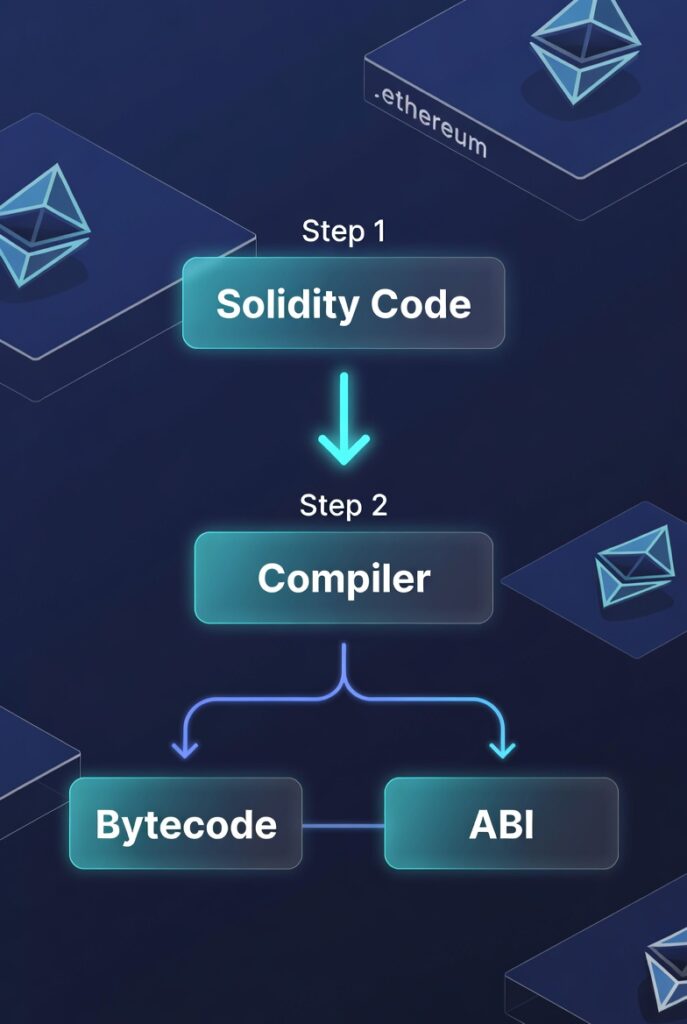
Once a smart contract’s logic is written in Solidity, it must undergo a compilation process. The Solidity compiler (solc) transforms the human-readable script into two essential components:
- Bytecode: A dense, hexadecimal stream of operational codes (opcodes) that can be read and processed directly by the blockchain’s execution engine.
- Application Binary Interface (ABI): A standard interface format that allows external web applications, front-end software, and user wallets to interact seamlessly with the deployed contract on-chain.
The Ethereum Virtual Machine (EVM) and Global Consensus
When the bytecode is compiled, the developer wraps it in a special on-chain transaction and broadcasts it to the network. Miners or validators pull this transaction from the mempool and record it onto the immutable ledger, assigning it a unique contract address. From that moment forward, the contract lives on the blockchain forever and cannot be altered or deleted, a trait known as immutability.
When a user triggers a function within that smart contract—for example, sending funds to a lending pool—the contract’s bytecode is executed across thousands of nodes simultaneously via the Ethereum Virtual Machine (EVM). The EVM is a sandboxed, isolated execution environment that operates as a single, global, virtual state machine. Every validator on the network executes the code independently using the exact same inputs. If the outputs match across the majority of the network, consensus is reached, the transaction is finalized, and the global state of the blockchain updates uniformly.
The Economics of Computation: The Gas Mechanics
Because smart contracts run on thousands of independent computers globally, an adversarial actor could easily disrupt the entire network by deploying an infinite loop or a malicious script designed to consume all available computational resources (a classic Denial-of-Service attack). To prevent this structural vulnerability, smart contract networks implement an economic throttling mechanism known as Crypto Gas Fees.
Every single cryptographic opcode executed by the EVM has a fixed, unalterable cost measured in gas units. For example, adding two numbers costs 3 gas, while writing a new piece of data to the blockchain’s storage costs 20,000 gas. When a user submits a transaction to a smart contract, they must specify a “Gas Limit” and pay a “Gas Price” in the network’s native currency (e.g., ETH). If the contract code executes successfully, the unused gas is returned to the user. However, if the code hits an infinite loop or runs out of the allocated gas before completion, the EVM immediately halts execution, reverts all state changes back to their original form to maintain network integrity, but keeps the spent gas to compensate validators for their consumed hardware power.
4. The Engine of Tokenization: Standardizing Crypto Assets
One of the most profound applications of smart contract technology is the creation and management of crypto tokens. Prior to smart contracts, launching a new digital asset required building an entirely independent blockchain infrastructure from scratch, including setting up a consensus mechanism, a validator network, and wallet integrations. Smart contracts completely democratized this paradigm by introducing token standards directly on top of existing secure networks.
A crypto token on a smart contract network is not an independent physical digital file. Instead, it is simply a highly organized database ledger stored within a specific smart contract. The smart contract acts as the absolute source of truth, keeping track of an internal mapping table that maps specific public wallet addresses to their corresponding token balances.
| Token Standard | Asset Type | Core Characteristics | Primary Use Cases |
|---|---|---|---|
| ERC-20 | Fungible Tokens | Identical, interchangeable units; divisible; uniform value across the network. | Utility tokens, governance tokens, stablecoins (USDT, USDC, LINK, UNI). |
| ERC-721 | Non-Fungible Tokens (NFTs) | Completely unique units; non-divisible; contains distinct metadata properties. | Digital art, collectibles, real-world asset tokenization, virtual real estate. |
| ERC-1155 | Multi-Token Standard | Can manage fungible and non-fungible assets simultaneously within a single deployment. | Web3 gaming assets, complex supply chains, multi-tiered reward ecosystems. |
When you “transfer” an ERC-20 token to another wallet, you are not moving data between devices. Instead, you are sending a signed cryptographic instruction to the token’s smart contract address. The smart contract evaluates your digital signature, checks if your wallet balance is greater than or equal to the amount requested, subtracts the balance from your row in the internal table, and adds it to the recipient’s row. This uniform standardization allows any decentralized exchange, protocol, or hardware wallet to immediately recognize and trade thousands of different tokens natively without needing unique integrations for each one.
5. Dissecting Decentralized Applications (DApps)
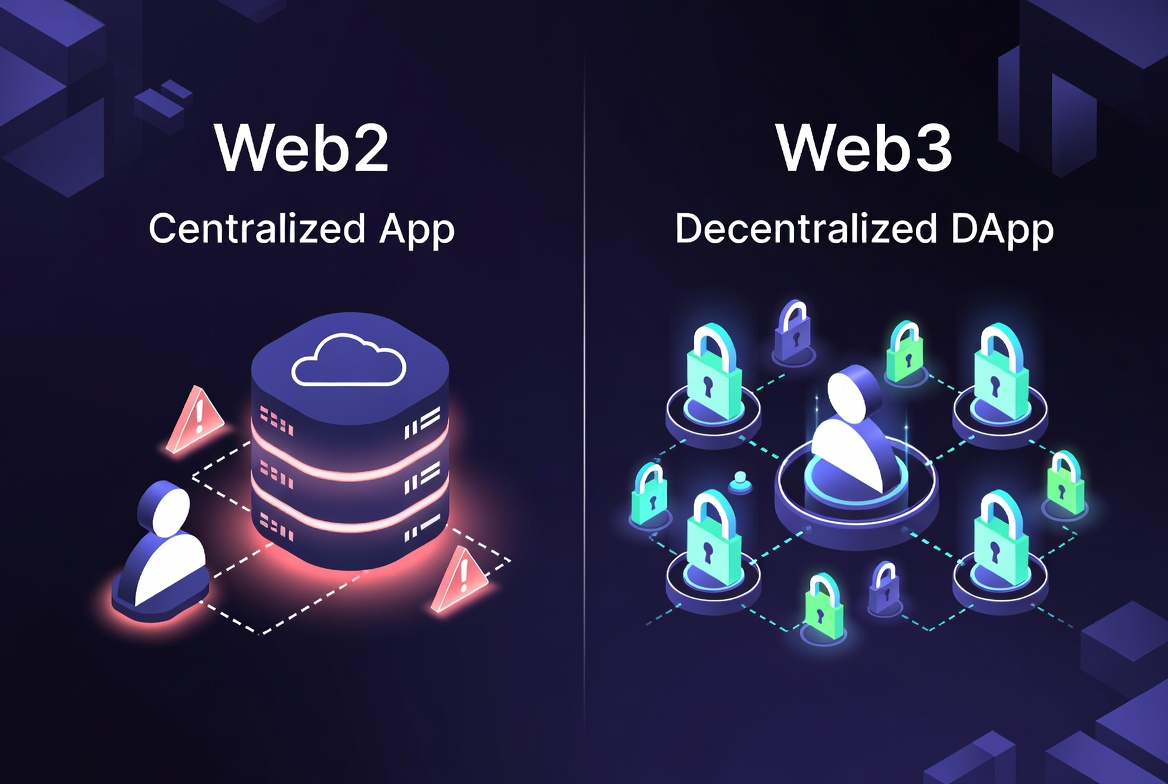
While tokens represent standard data management, Decentralized Applications (DApps) represent the holistic realization of smart contract capability. A DApp is an application that looks, feels, and operates like a standard mobile app or website, but with one critical architectural difference: its back-end logic is entirely powered by a decentralized smart contract network rather than a centralized corporate database server.
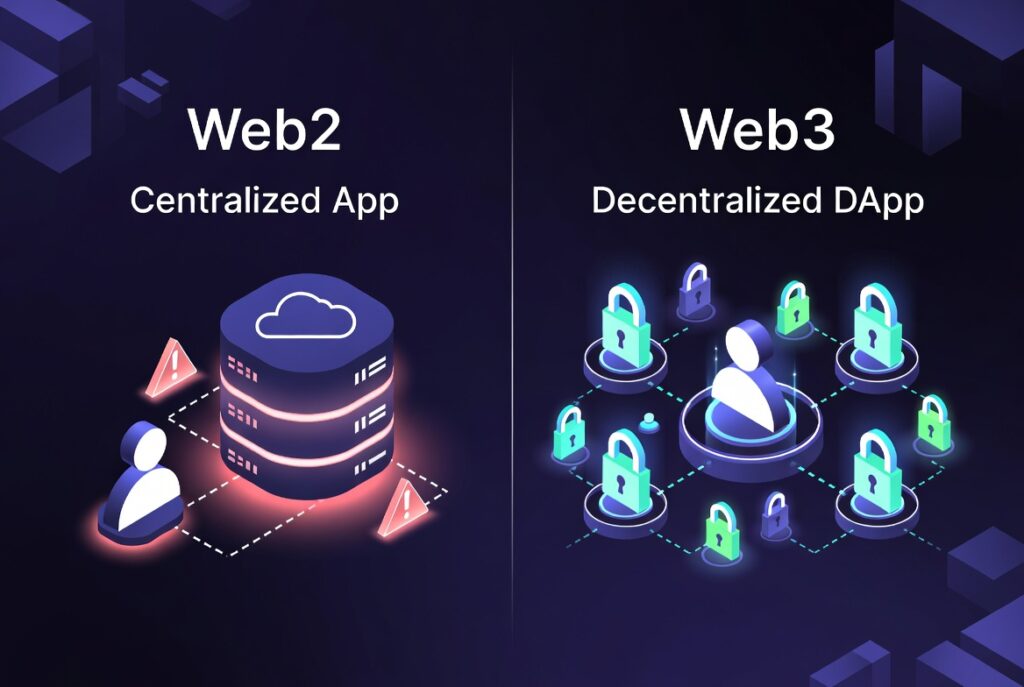
FigFig 2. The structural paradigm shift from legacy centralized client-server frameworks (Web2) to peer-to-peer, smart contract-driven decentralized applications (Web3). 2. Structural breakdown of a Decentralized Application (DApp) ecosystem, showcasing the connection between peer-to-peer networks and money applications.
To fully appreciate the paradigm shift of DApps, consider the structural difference in a standard web architecture compared to a Web3 DApp:
- Traditional Web Architecture (Web2): The user interacts with a web browser user interface (Front-end). When an action is taken, the front-end makes an API call across the internet to a centralized server (Back-end) hosted by a cloud provider like Amazon Web Services (AWS) or Google Cloud. This back-end queries and updates a centralized relational database (e.g., SQL). The corporation retains absolute control over the data, can ban users, and presents a single point of failure for hackers.
- Decentralized Architecture (Web3 DApp): The user still interacts with a standard front-end built with HTML, CSS, and JavaScript. However, instead of connecting to a centralized API, the front-end utilizes Web3 javascript libraries (such as Ethers.js or Web3.js) to communicate with an RPC node provider. This node speaks directly to the blockchain network. The back-end database and logic are replaced entirely by a network of smart contracts. The user logs in using a cryptographic browser extension wallet (such as MetaMask) rather than an email and password, ensuring complete ownership of their digital identity and funds.
By shifting the core back-end to a smart contract network, DApps achieve unprecedented properties: they are inherently censorship-resistant (no centralized government or corporation can turn off the smart contract), they boast 100% historical uptime due to the distributed nature of the validator network, and they are completely open-source, allowing anyone globally to audit the exact logic governing the platform.
6. The Security Matrix: Auditing, Vulnerabilities, and Legal Pitfalls
While the architectural benefits of smart contracts are profound, their greatest strength is also their most significant security vulnerability: immutability. In traditional software development, if a engineer deploys a web application containing a bug or a critical security exploit, the team can quickly patch the code on their centralized server within minutes. On a public blockchain, once a smart contract is deployed, its code cannot be altered under any circumstances.
This immutable “code-is-law” philosophy means that if a developer accidentally introduces a mathematical logic flaw or an architectural oversight into a smart contract, that flaw is visible to hackers globally. Malicious actors can exploit the vulnerability to drain billions of dollars worth of locked user assets out of the contract, with absolutely no mechanism for traditional bank chargebacks or centralized system rollbacks.
The Menace of Reentrancy Attacks
The most historically significant and destructive vulnerability in smart contract history is the Reentrancy Attack. This specific exploit occurs when a smart contract sends funds to an untrusted external contract before updating its internal balance tracking. The receiving malicious contract can hijack the execution thread and iteratively call the withdrawal function over and over again in a recursive loop before the victim contract ever has the chance to update its balance state.
This exact vulnerability was exploited in the famous 2016 **DAO Hack**, where an attacker drained over 3.6 million ETH from a decentralized venture fund. The exploit was so cataclysmic that it forced the Ethereum community to execute a highly controversial hard fork to recover the stolen funds, splitting the network into Ethereum (ETH) and Ethereum Classic (ETC). Today, mitigating reentrancy requires strict adherence to the *Checks-Effects-Interactions* programming pattern or the integration of reentrancy guard modifiers in the code.
The Crucial Role of Smart Contract Audits
To navigate this hostile execution environment, the Web3 ecosystem has developed a multi-layered, specialized security auditing industry. Before deploying a smart contract handling significant capital, projects must undergo rigorous code audits conducted by elite cybersecurity firms (such as OpenZeppelin, CertiK, and Trail of Bits).
An institutional-grade smart contract audit involves:
- Static Analysis: Running the codebase through automated software tools to scan for known vulnerability signatures, compiler bugs, and optimization inefficiencies.
- Formal Verification: Using mathematical models and proofs to systematically prove that the smart contract logic will behave exactly as intended under every single conceivable state condition.
- Manual Code Review: Human cryptographers and security engineers meticulously analyzing the economic incentives, logic flows, and edge cases of the contract to look for logical flaws or manipulation potential like flash-loan price oracle manipulation.
7. Disruptive Real-World Use Cases
As the maturity of high-speed Layer-2 scaling solutions and zero-knowledge privacy layers accelerates, smart contracts are rapidly moving beyond simple speculative token exchanges and disrupting multi-trillion dollar traditional industries:
- Decentralized Finance (DeFi): Smart contracts have completely automated traditional banking operations. Protocols like Uniswap use Automated Market Makers (AMMs) to allow instant token swapping without an order book. Platforms like Aave use smart contracts to pool liquidity, allowing users to instantly borrow or lend crypto assets by over-collateralizing their positions, with interest rates adjusting algorithmically based on supply and demand dynamics.
- Supply Chain Management: Smart contracts can interface with IoT (Internet of Things) tracking sensors to revolutionize logistics. For example, a contract handling a shipment of temperature-sensitive pharmaceuticals can automatically release payment to the logistics provider the exact second the cargo arrives at the destination dock—provided the internal sensor proves the temperature never exceeded a safe threshold during transit.
- Decentralized Autonomous Organizations (DAOs): Corporate governance is being reinvented through smart contracts. A DAO replaces a traditional corporate board of directors with decentralized voting code. Token holders submit governance proposals on-chain. If the proposal receives a majority of cryptographic votes within a specified timeframe, the smart contract automatically executes the proposal code, transferring funds or upgrading the platform protocol without needing executive intervention.
8. Conclusion: The Autonomous Future of Global Agreements
Smart contracts represent a fundamental turning point in how humanity organizes economic and social cooperation. By turning legal prose into unalterable, mathematical code, they eliminate the need for blind trust in centralized institutions. They create an open, permissionless financial playground where anyone with an internet connection can engage in complex financial transactions with absolute settlement finality.
The transition toward an autonomous digital world is not without structural roadblocks; scalability constraints, user interface complexities, and severe state-level regulatory uncertainty present real hurdles. However, the foundational utility of smart contract technology is undeniable. As the technology continues to mature, smart contracts will quietly weave themselves into the invisible fabric of global commerce, cementing their legacy as the definitive backend infrastructure for the trustless internet of value.